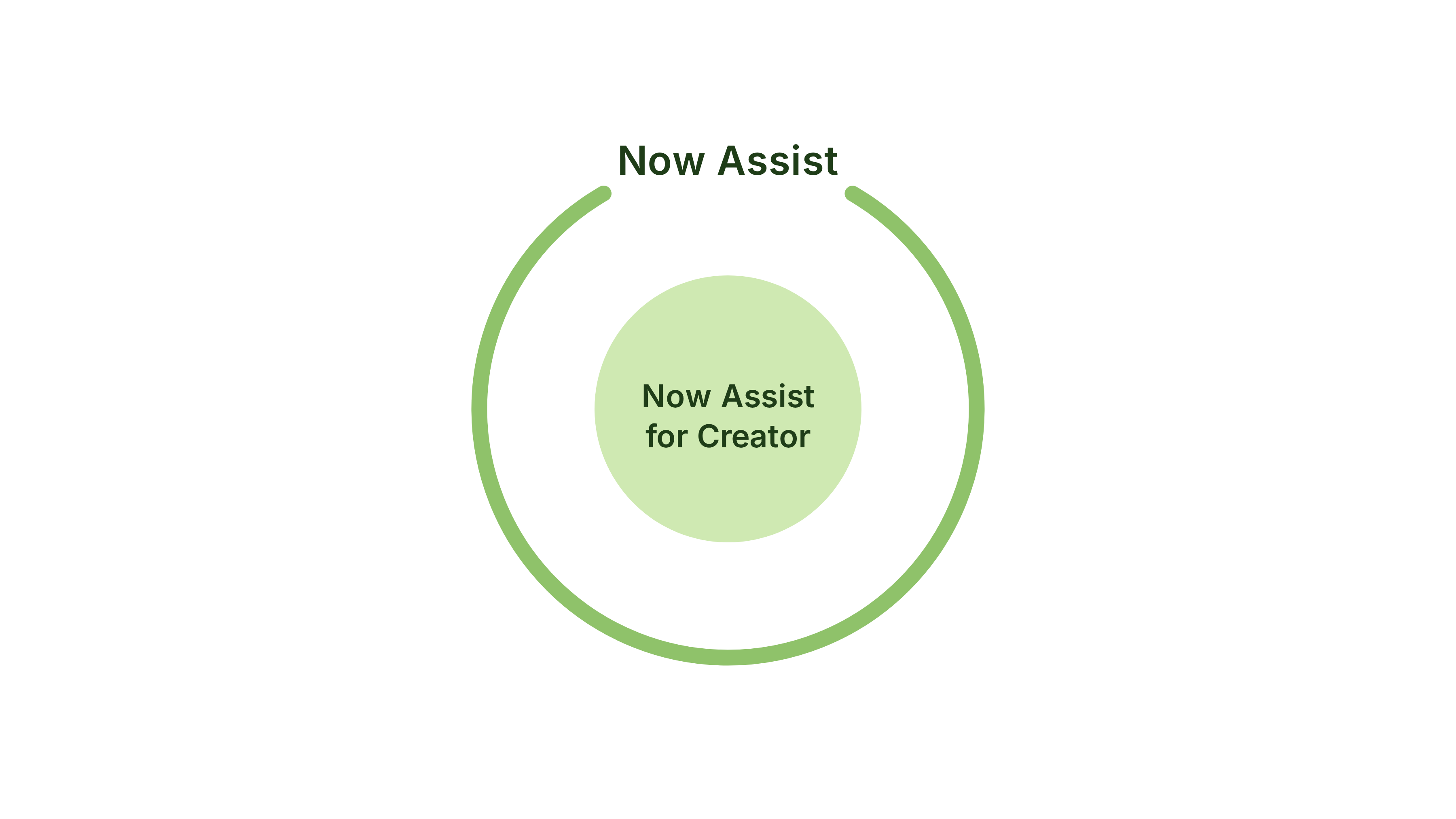
Buyers searching for "Now Assist vs Now Assist for Creator" are usually trying to pick one, because the phrase seems like two separate SKUs on a shortlist. However, the two names sit at different levels of one product structure, so this blog describes that structure and places Creator inside it.
The short answer.
Now Assist is a family of per-product apps, one for each workflow. Now Assist for Creator is the app in that family for people who build on the platform, and ServiceNow's install page states it "requires a separate subscription." We'll dive into how the licensing works, what Creator includes, and where buyers most often go wrong in their process.
A quick note on the name: ServiceNow is renaming Now Assist to ServiceNow Otto, and the release notes state that "Your product entitlements remain unchanged." This post uses Now Assist throughout, because that is the name on most contracts today. More on that in the rename section.
On this page.
- The three layers behind every Now Assist SKU
- The Otto rename, and what it changes
- What Now Assist for Creator includes
- Now Assist for Creator requires a separate subscription
- What Now Assist for Creator does not include
- Now Assist assists: how consumption is metered
- What ServiceNow does not publish
- Where buyers get Now Assist licensing wrong
- How to choose between Now Assist SKUs
- Now Assist licensing FAQ
- Key takeaways
Now Assist licensing at a glance.
| Question | Answer |
|---|---|
| Are Now Assist and Now Assist for Creator alternatives? | Now Assist is the family. Creator is one app inside it, for developers and configurers. |
| Does an ITSM Now Assist entitlement cover Creator? | Creator is entitled on its own. Its install page says it "requires a separate subscription." |
| What decides the tier? | Foundation, Advanced, and Prime, set per product. Creating net-new custom AI skills and agents is Prime only. |
| What drives ongoing Now Assist pricing? | Assists, metered per invocation, from 1 for chat summarization to 2,500 for app generation. |
| Does the Otto rename change entitlements? | ServiceNow's release notes state: "Your product entitlements remain unchanged." |
| What is undocumented? | Assist volumes, list prices, the tier-to-skill mapping, which tier Creator requires, and the status of Pro Plus and Enterprise Plus. |
The three layers behind every Now Assist SKU.
Three separate things get called the Now Assist SKU: the tier, the product app, and the assist entitlement. Each is bought on a different axis, and a deployment works when all three line up.
| Layer | What it is | How it is bought |
|---|---|---|
| Tier | Foundation, Advanced, or Prime, set per product | Part of the product subscription, such as ITSM Advanced or CSM Prime |
| Product app | The Now Assist app for one workflow: ITSM, CSM, HRSD, ITOM, SPM, FSM, Security Incident Response, IRM, or Creator | Installed from the ServiceNow Store against an entitlement |
| Consumption | Assists, metered per skill invocation | A separate entitlement, drawn down as skills run |
A tier without the installed app delivers nothing, and an installed app draws down assist entitlement every time a skill runs. ServiceNow may invoice for usage beyond that entitlement.
The tier: Foundation, Advanced, and Prime.
ServiceNow's product tiers documentation, which followed the 9 April 2026 packaging announcement, states that "ServiceNow structures its products and packages in three tiers" and names them Foundation, Advanced, and Prime.
| Capability | Foundation | Advanced | Prime |
|---|---|---|---|
| AI skills and routine AI agents | Supported | Supported | Supported |
| Configure out-of-the-box skills and agents | Supported | Supported | Supported |
| Agentic workflows with contextual AI synthesis | Supported | Supported | Supported |
| MCP Server Console (inbound) | Supported | Supported | Supported |
| Platform Analytics Advanced | Not supported | Supported | Supported |
| Create net-new custom AI skills and agents | Not supported | Not supported | Supported |
| Autonomous AI workforce (AI Specialists) | Not supported | Not supported | Supported |
Two rows of the tier table carry the decision weight. Configuring out-of-the-box skills and agents works at every tier, and creating net-new custom AI skills and agents requires Prime. That is the cleanest capability boundary ServiceNow publishes.
Tiers are set per product. The ITSM pricing page lists ITSM Foundation, ITSM Advanced, and ITSM Prime as separate line items, so ITSM Prime tells you nothing about your CSM or HRSD entitlement. Price each product line on its own, which is where an instance-first readiness plan earns its keep.
The product app: one Now Assist app per workflow.
Now Assist ships as a separate Store app per workflow, each entitled on its own. ServiceNow documents apps for ITSM, CSM, HRSD, ITOM, SPM, FSM, Security Incident Response, IRM, and Creator. ITSM covers incident summarization, resolution notes, Incident Assist, Knowledge Assist, and Chat Assist. CSM covers case summarization and resolution notes, and the data model prerequisites for Now Assist for CSM decide how well those skills perform.
Across the Now Assist product documentation, the licensing language is tier boilerplate rather than a named SKU requirement. The CSM supporting information page is representative: "Depending on your license, you will have access to certain application features, generative AI skills, agentic workflows, and AI agents." One hard subscription statement exists in the documentation set, on Creator's install page.
The Otto rename, and what it changes.
The Australia release notes state: "ServiceNow Otto is the new AI experience brand. This change is reflected in the name of ServiceNow products." Entitlements survive the rename. The same page says: "Your product entitlements remain unchanged. Check your entitlements to determine your access to specific features."
The Otto rollout is uneven, and ServiceNow says so. Its quick-start guide reads: "Otto is replacing the Now Assist name in our product and content. In some cases, the switch-over will be uneven; please pardon our dust." Documentation URLs still contain now-assist-for-creator while page titles read "ServiceNow Otto for Creator," so both names will appear in one conversation with your account team.
The migration to Foundation, Advanced, and Prime is a separate commercial event running alongside the rename, and practitioners report conflicting guidance on whether existing commitments carry across. Work through the seven questions worth asking before you renew ServiceNow before signing anything.
What Now Assist for Creator includes.
Now Assist for Creator is the app that makes people who build on the platform faster. The product landing page, updated 28 July 2026, names these capabilities: App Generation, App Summary Generation, ATF Troubleshooting Agent, Build Agent, Catalog Item Generation, Code Generation, Flow Generation and Recommendations, Flow Summarization, Mobile Card Generation, Playbook Generation, Process Mining, Release Lifecycle Documentation, RPA Bot Generation, Test Generation, and Theme, UI, and Widget Generation.
The capability list describes one audience: developers, admins, and configurers. A service desk, an HR case team, or a customer service team gets nothing from Now Assist for Creator, and those workflows are separate purchases. The ATF Troubleshooting Agent and Test Generation are the capabilities buyers most often overlook, because regression work is where the time cost of ATF testing concentrates at every upgrade.
Now Assist for Creator requires a separate subscription.
ServiceNow's install page states it plainly: "ServiceNow Otto for Creator requires a separate subscription." That sentence names no tier at all. Pro Plus, Enterprise Plus, App Engine, and Creator Workflows appear nowhere on the page. The operative word is separate, and it matters most to anyone assuming an ITSM or CSM AI entitlement extends to development tooling.
The install page also lists the technical requirements: the admin role, Washington DC Patch 1 or later, Next Experience enabled, the scoped application sn_now_creator, and the now.assist.creator role for every user who will run the skills.
What Now Assist for Creator does not include.
AI Skill Kit, previously Now Assist Skill Kit, is documented as its own product on pages separate from Creator. No ServiceNow page states that Now Assist for Creator entitles you to Skill Kit. If a vendor or partner has told your team that buying Creator delivers custom skill authoring, ask which page says so.
Creating net-new custom AI skills and agents is Prime only, per the product tiers documentation. Now Assist for Creator supplies generation tooling, and the right to build new AI capability is a tier question. A team can hold a Creator subscription and still lack the entitlement to author a custom skill.
Now Assist assists: how consumption is metered.
An assist is "a unit used to measure usage of Now Assist skills via performed skill actions," per the Now Assist Overview, the contractual document effective 14 August 2026. Assists draw from an account-level entitlement, aggregate daily, and reset "each year on the anniversary of the date Customer first purchased an Advanced AI and Data Product."
Skill prices span three orders of magnitude, across a rate card of roughly 290 rows. The sample below carries assist values verbatim, with labels shortened.
| Skill | Assists per invocation |
|---|---|
| Chat summarization | 1 |
| Code generation | 5 |
| Knowledge article generation | 10 |
| Agentic workflow, small (under 4 actions) | 25 |
| Test case generation | 50 |
| Agentic workflow, large (9 to 20 actions) | 150 |
| Widget generation | 500 |
| RPA bot generation | 500 |
| Flow generation (using images) | 500 |
| Experience (UI) generation | 1,000 |
| App generation | 2,500 |
| Playbook generation | 2,500 |
Summarization is cheap, generation is expensive, and the Creator-heavy skills sit at the top of the card. A team running app generation in a sandbox to learn the tool can burn more entitlement in an afternoon than a service desk burns summarizing incidents for a month. Custom skills built with Skill Kit are charged custom call pricing, set at 1 assist per LLM call, with the qualifier that "Calls exceeding 1,000 output tokens are considered multiple calls."
Four provisions in the Now Assist Overview catch buyers out. Sub-production instances consume assists: "Customer's use of Now Assist skills will consume assists, whether in production or sub-production instances." Dev and test draw down the production pool.
Bringing your own model still meters. Customers invoking out-of-the-box skills "will be charged the respective assist price of the skill... irrespective of the model provider or LLM infrastructure being used." Routing inference to your own Azure OpenAI tenant changes who pays for the tokens, and the assist charge holds.
Overage is invoiced. The Overview states: "If at any time Customer's aggregated assist usage exceeds its assist entitlement, ServiceNow may invoice Customer for the excess usage." Skill mix drives that exposure more than headcount does, because two teams of the same size can differ a thousandfold in consumption.
Usage is tracked in Subscription Management, which requires the usage_admin role. Practitioner experience in a January 2026 Community thread reports that metering happens off-platform: "these are events are metered outside the Servicenow instance and you get only a aggregated numbers."
What ServiceNow does not publish.
Five gaps matter most in a Now Assist purchase, and naming them beats guessing at them.
Assist entitlement volumes and list prices are unpublished. No ServiceNow page states how many assists come with any tier, or what any tier costs. The weighting behind the rate card is also undisclosed, and a practitioner who asked was told it is ServiceNow internal.
The tier-to-skill mapping is unpublished. ServiceNow publishes capability lists and tier definitions on separate pages and does not join them, and Store licensing panels sit behind authentication.
Which tier Now Assist for Creator requires is unpublished. The install page names a separate subscription and stops there.
The status of Pro Plus and Enterprise Plus is unpublished. Both are absent from current pricing pages, while a ServiceNow-authored FAQ last updated 13 December 2025 still instructs customers to "Ensure that the instance is entitled to a Pro Plus/Enterprise Plus SKU." That article predates the April 2026 repackaging, so treat it as stale. Every gap above belongs in a contract rather than a slide.
Where buyers get Now Assist licensing wrong.
The corrections below come from ServiceNow Community threads and r/servicenow. They are practitioner experience rather than documentation, and every entitlement claim in this post rests on documentation alone.
"We have Pro, so we have Pro Plus." A Community Mega Guru corrected a customer holding ITSM Pro: "The 'Pro' license you have is not the same as 'Pro Plus.' 'Pro Plus' includes additional features, such as Now Assist for ITSM." The tier names have since changed, and the principle that AI capability is entitled beyond the base product has held.
"It is a plugin, so it is included." A 2024 Community thread drew three separate corrections, ending with "Now Assist is a premium feature in ServiceNow and requires a separate license." An October 2025 poster hit "Instance not entitled" during install after assuming an enterprise-level subscription implied entitlement. Entitlement is a separate authorization from subscription size.
"We bought Now Assist and tier one volume stayed flat." The most-discussed r/servicenow thread on Now Assist came from a customer who bought it expecting automated password resets and got a virtual agent that escalated most requests. A commenter identified the mismatch: "most of the Now Assist value is not there, it is in the skills, agents and agentic workflows." Deploying the conversational surface alone tests one narrow slice, and responders named knowledge base quality as the constraint.
How to choose between Now Assist SKUs.
Work through these five questions in order, because a later one is moot if an earlier one rules an option out.
- Which workflow has the pain? Buy the Now Assist app for that workflow. Cross-product AI entitlement does not exist, so the answer is a list of separate purchases.
- Are you configuring what ships, or building what does not? Configuring out-of-the-box skills and agents works at Foundation. Creating net-new custom AI skills and agents requires Prime, so a business case resting on custom skills has Prime as its floor.
- Do your developers need to move faster? That is Now Assist for Creator, and it is a separate subscription regardless of what else you own.
- What will you invoke, and how often? Multiply expected monthly volume by the rate card, then add dev and test, because sub-production consumes from the same pool.
- What has your account team put in writing? Prices, assist volumes, the tier-to-skill mapping, and the fate of a Pro Plus commitment are undocumented publicly, so each belongs in the contract.
The short version: the workflow decides the app, the build-versus-configure question decides the tier, Now Assist for Creator is always separate, and the rate card decides whether the business case survives your volume.
Now Assist licensing FAQ.
Does Now Assist include Now Assist for Creator?
Now Assist for Creator is entitled separately from the other Now Assist apps. Now Assist is a family of per-product apps covering ITSM, CSM, HRSD, ITOM, SPM, FSM, Security Incident Response, IRM, and Creator. ServiceNow's install page states that ServiceNow Otto for Creator requires a separate subscription.
What is the difference between Now Assist and Now Assist for Creator?
Now Assist is the family name for ServiceNow's per-product AI apps. Now Assist for Creator is the app in that family for people who build on the platform, covering app generation, code generation, flow generation, test generation, and Build Agent. The other apps serve people who work cases.
Does Now Assist for Creator require Prime?
ServiceNow does not publish which tier Now Assist for Creator requires. The install page states only that it requires a separate subscription, and it names no tier. The product tiers documentation does state that creating net-new custom AI skills and agents is Prime only.
Is Now Assist included in my ITSM license?
Now Assist for ITSM is entitled separately from a standard ITSM license. A ServiceNow Community expert has corrected customers holding ITSM Pro, noting that Pro Plus includes additional features such as Now Assist for ITSM. Under the April 2026 packaging the tiers are Foundation, Advanced, and Prime.
Do sub-production instances consume assists?
Sub-production instances consume assists. The Now Assist Overview states that customer use of Now Assist skills will consume assists, whether in production or sub-production instances. Development and test instances draw down the same account-level pool as production, so budget dev and test volume alongside production.
Key takeaways.
- Now Assist is a family of per-product apps, and Now Assist for Creator is one of them.
- ServiceNow's install page states that Now Assist for Creator "requires a separate subscription," and it names no tier.
- Foundation, Advanced, and Prime are set per product, and creating net-new custom AI skills and agents is Prime only.
- Assists meter every invocation, from 1 for chat summarization to 2,500 for app generation, and sub-production instances count.
- Assist volumes, prices, the tier-to-skill mapping, and the status of Pro Plus are unpublished, so put them in the contract.
Echelon builds AI delivery for ServiceNow, including the readiness and entitlement mapping that decide whether Now Assist skills land. To have the three layers checked against your contract and instance, book a scoping call.